Searching for Answers
For Norgaard, a biochemistry major with a STEM research minor and nutrition concentration from Cottage Grove, MN, SURVE confirmed that scientific research is exactly where she belongs. Working alongside
Dr. James Peliska, dean of the School of Arts and Sciences, professor of biochemistry and chemistry, and Fellow in Catholic Studies, she is helping advance research aimed at understanding HIV and overcoming drug resistance.
“My experience in SURVE has solidified my dream of pursuing a career in research,” she said. “Research is exciting, yet frustrating at times. There are moments of great success and also many moments of challenge. Because of these challenges, a career in research requires passion and patience.”
Peliska says that while today’s HIV therapies have transformed countless lives, the disease remains a global health challenge.
“There is currently no cure for individuals infected with HIV,” Peliska said. “While treatments have reduced the impact of HIV/AIDS, it remains a major global health challenge.”
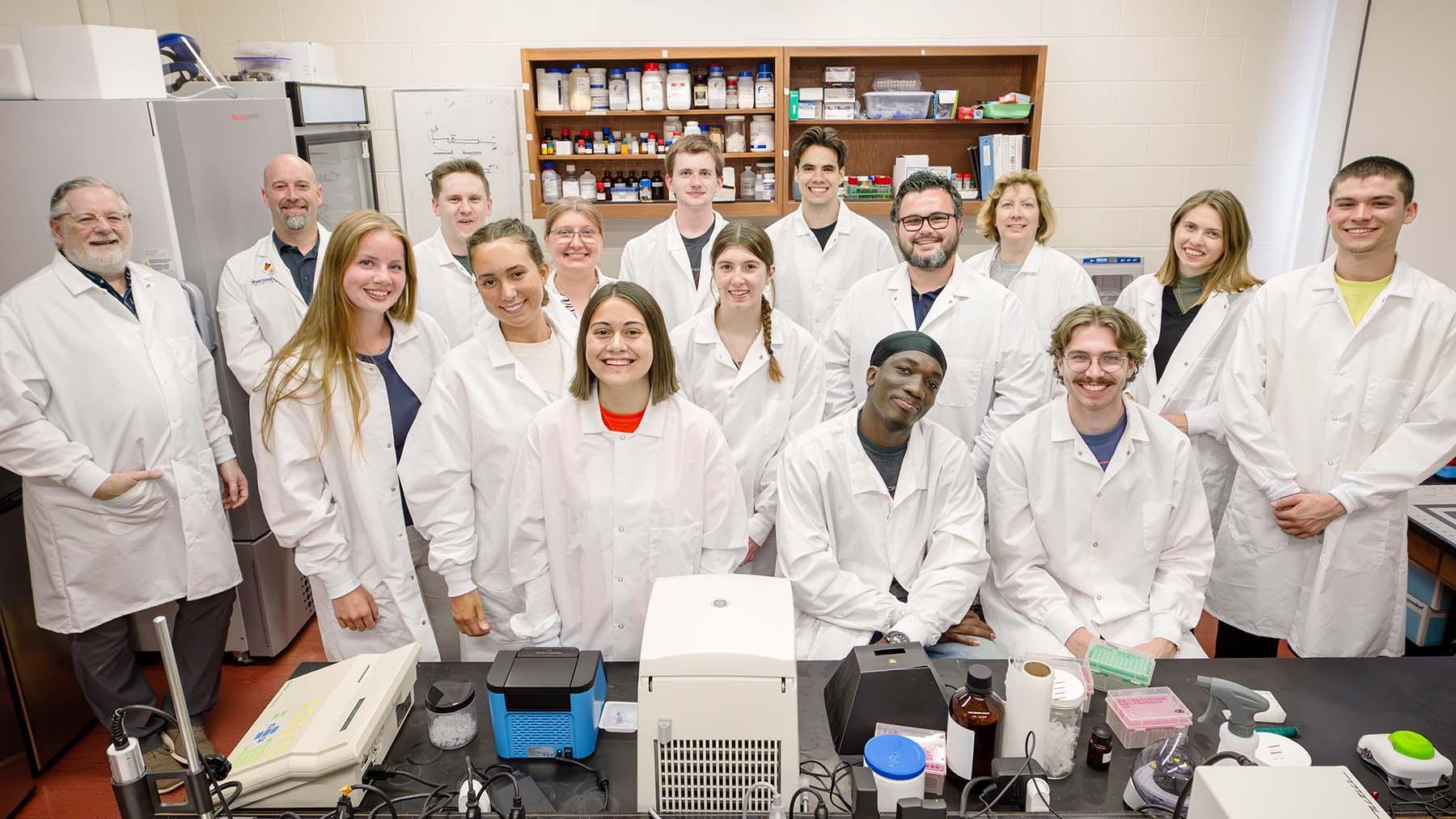
Back in the shared laboratory, Walker, a music and pre-med major from Fargo, ND, investigates cancer biology with Dr. Joseph Biggane, associate professor of biology and chair of natural sciences. Walker hopes to attend medical school after graduating in 2027 and says research has broadened the way he thinks about medicine.
“The mystery of it is exciting,” Walker said. “In any form of cancer research, there is a very real possibility that you might discover something completely new and unexpected. And being part of that process is amazing to me.”
Walker, who also sings with the university’s internationally acclaimed Cappella choir, sees an unexpected connection between music and science.
“Research and making music are really quite similar,” he said. “Both are ultimately processes of trial and error and experimentation.”
Biggane says SURVE students don’t simply observe.
“The students really run the show in my lab,” he said. “Participating in real biomedical research gives them an opportunity to contribute to new discoveries. It’s what most kids dream of when they think they might want to be a scientist one day. So, it’s rewarding when students tell me this experience has helped them become confident in becoming scientists.”
In a different laboratory, Harms, a biology and biochemistry major from Bismarck who plans to become a research technician, carefully performs a plaque assay while Dr. Christine Fleischacker, associate professor of biology and Fellow in Catholic Studies, watches nearby, discussing each step of the experiment. Together, they are investigating bacteriophage therapy as a possible future weapon against antibiotic-resistant bacteria.
“I hope this research will have clinical implications regarding drug-resistant bacteria,” Harms said. “SURVE has definitely been an influence on my scope of science. Hearing from faculty has helped me solidify my career goals.”
Fleischacker says one of the most rewarding parts of the program is mentoring students and watching them grow in confidence, curiosity, and purpose.
“They are learning firsthand how to troubleshoot, interpret data and communicate science,” she said, “while also reflecting on what it means to live as a scientist.”
More Than a Career
This summer marks SURVE’s 10th year. After National Institutes of Health funding was restored, students once again filled the Harold J. Miller Center laboratories, where research is paired with weekly discussions exploring faith and reason, vocation, community, ethics, and the pursuit of truth.
“A scientific life has the potential to be much more than a career,” Ronderos said. “If done well, it can be a way to live out one’s faith, exercise charity toward our neighbor, serve the advancement of truth, and bring Christ to every part of society.”
Walker says the experience has changed how he views both science and his future.
“The more I know about the natural world, the more I can thank my Creator for my place in it,” he said. “SURVE has taught me that the whole scientific enterprise is ordered toward good. Scientists usually do their work to help others and make the world a better place.”
Peliska believes that perspective is what distinguishes SURVE from many undergraduate research programs.
“Students not only participate in exciting research projects and learn valuable laboratory techniques, but they also learn how to think as scientists,” he said. Quoting Saint Pope John Paul II’s Ex Corde Ecclesiae, Peliska added: “‘The cause of the human person will only be served if knowledge is joined to conscience.’”
Peliska says that philosophy guides every aspect of the program.
“This is what is often missing from scientific thought, discourse, and practice in the world today,” he said. “We want more for our students.”
The students come to SURVE looking for scientific answers. They leave discovering something even greater: a vocation.