

Healing Hands, Changing Lives: University of Mary Pro-Bono Clinics Transform Care, One Patient at a Time
From life-changing therapy to lifelong habits of health, students and patients together redefine compassionate, community-centered care in Bismarck-Mandan
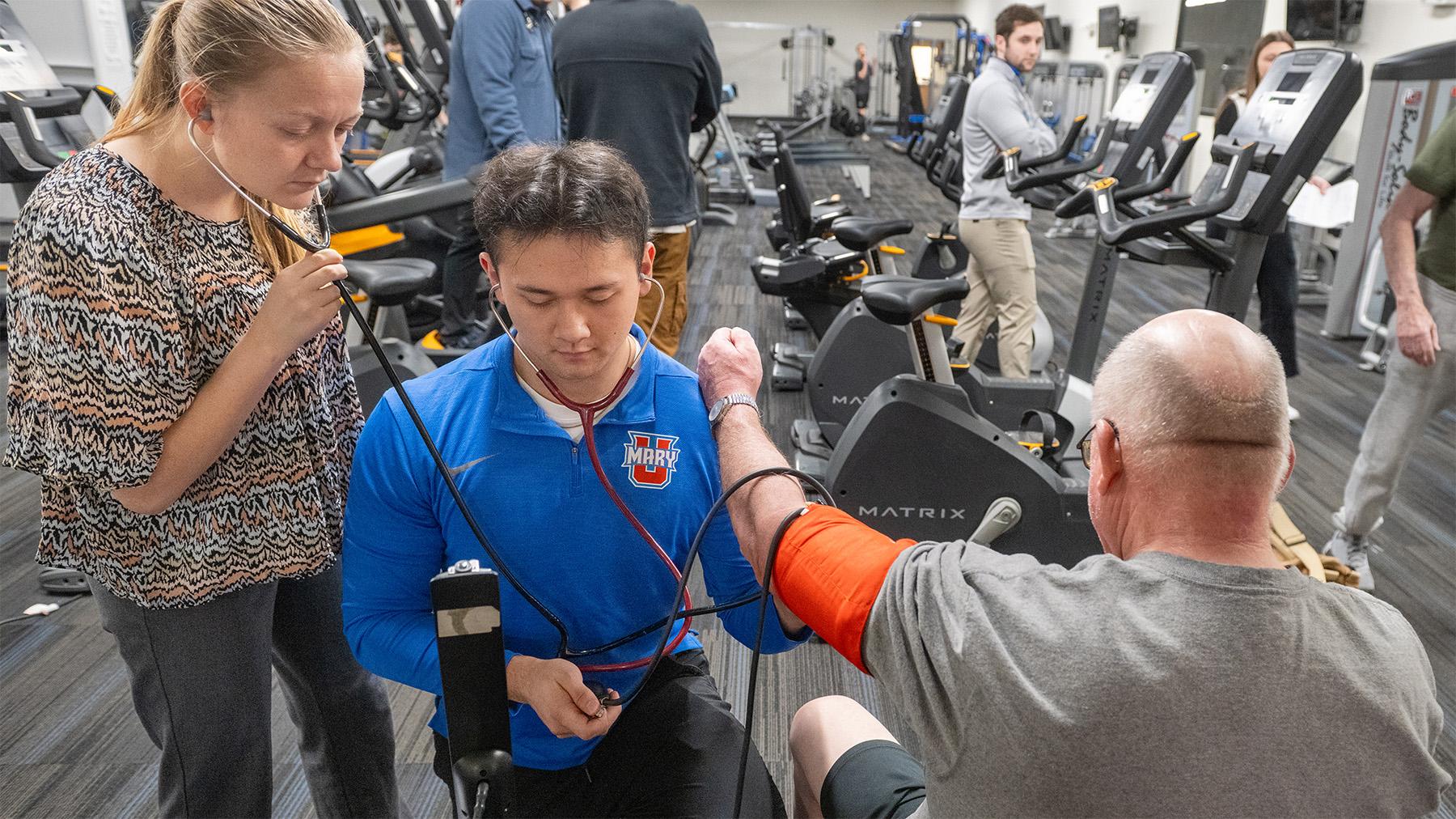
BISMARCK, N.D. — At 6:30 a.m., long before most of the city stirs, 74-year-old Daryl Hill is already moving—tracking his blood pressure, logging his progress, and pushing through another carefully guided workout. What began as a simple referral has become a way of life.
“Initially, I think it was curiosity,” Hill said. “I didn’t know what to expect… As time went on, the motivation transformed into a positive routine.”
Hill, a participant in the University of Mary’s pro-bono exercise science clinic, is one of hundreds of community members whose lives have been quietly transformed through the University of Mary’s pro-bono clinics—an expansive, mission-driven initiative within the Saint Gianna School of Health Sciences that has served the Bismarck-Mandan community for more than 20 years.
A Mission in Motion
“For more than two decades, the University of Mary’s pro bono clinics have embodied the heart of our mission: forming servant leaders committed to the common good,” said Dr. Mary Dockter, dean of the College of Health Professions and vice president for Medical Education and Partnerships.
Across five disciplines—speech-language pathology (helping children and adults improve communication and speech), physical therapy (restoring movement and function after injury or illness), occupational therapy (supporting daily living skills and independence), athletic training (preventing and treating sports-related injuries), and exercise science (designing safe, personalized fitness programs to improve overall health)—students provide care at no cost to individuals who are uninsured or underinsured, all under the supervision of experienced faculty. But what unfolds inside these clinics is far more than clinical training.
“In the pro bono clinics, students are immediately able to put that learning into practice with real patients who have real needs and real challenges,” Dockter said. “This transition… is transformative.”
More Than Exercise
For Hill, the transformation is both measurable and deeply personal. Over the years, he has built a disciplined routine—combining aerobic exercise, resistance training, and detailed health monitoring. His records now play a role in conversations with his healthcare providers.
“All I have to do is pull up my BP (blood pressure) records… and show them,” he said. “Without a doubt, the provider is very appreciative of that information.”
What keeps him coming back after a decade?
“The quality of service and commitment from the students,” Hill said.
And something more enduring.
“We get to help students perfect their skills, we receive high-quality care and advice, and there’s the social aspect,” he said. “All the participants are always visiting, talking, laughing.”
A few years ago, he heard a comment that stuck with him as a good philosophy to follow, simply: “motion is lotion”—a belief he credits for helping him maintain strength, flexibility, and even complete 122 miles of hiking on North Dakota’s Maah Daah Hey Trail.
A Family Commitment to Health
For Teresa and Vern Bleich, the exercise science clinic has become a shared rhythm of life.
“As I was getting older, I saw friends and family members slowing down… Thought I should do something about it,” said Teresa Bleich, 74.
She eventually convinced her husband to join.
“Teresa insisted that I start participating because it ‘would be good for me,’” Vern Bleich, 77, said with a smile.
Over time, what began as routine has become essential.
“I really believe that it is an excellent way to get and stay in the best condition I can be in,” Teresa said.
The clinic’s impact has even extended to early detection. When Vern’s heart rate spiked during a session, students and faculty-initiated follow-up care that led to further medical evaluation.
“If not for the clinic picking up on this anomaly it would have gone undiagnosed,” Teresa said.
For Vern, the value goes beyond personal health.
“I look at it as an opportunity… to be part of the education of future health professionals,” he said. “If I don’t continue, I will become less and less active. For now, this works.”
Learning That Lasts a Lifetime
For students, the clinics are where knowledge becomes vocation.
“The pro bono clinic was and is hands down my favorite part of the entire program,” said MacKenna Arnold-Weisser of Harvey, North Dakota, a graduate student in clinical exercise physiology. “It is such an amazing real-world application… for hands-on clinical skills, leadership, and communication,” she said.
The experience doesn’t just teach technique—it shapes purpose.
“Serving members of the community in this way is everything to me,” Arnold-Weisser said. “We get to advocate for healthy bodies to last a lifetime… and promote exercise as medicine.”
Grace Stroh of Bismarck, a graduate assistant studying occupational therapy, said the relationships formed in the clinic are just as impactful.
“Something as simple as talking to someone while they walk on the treadmill can make their day just a little bit better,” she said.
And for Tyler Thompson, an exercise science major from Oakes, ND, the experience reinforces why she chose healthcare.
“Ultimately, I just want to help the people who need it,” she said. “I remember what it was like… all I wanted was to get better and get back to doing what I loved. I want to help others do just that.”
Finding a Voice
Across campus, in the speech-language pathology clinic, a different kind of transformation is taking place—one measured not in steps or strength, but in confidence and communication.
When Hannah Venable brought her daughter Hosannah to the clinic, she struggled with sounds like “r” and “th.”
“She was sometimes hard to understand,” Venable said.
What followed was progress—and something deeper.
“She has really mastered the ‘th’ sound,” Venable said. She is still working on the “r” sound and is making good progress. She has become increasingly motivated and encouraged that she can improve.”
The experience has reshaped not only Hosannah’s speech, but her confidence.
“It has helped her not to be embarrassed, because she sees that others need help too and that there are people that can help her along the way” Venable said.
For student clinician Allie Blakeslee of Laurel, Montana, who works with Hosannah, the journey has been equally meaningful.
“Being a part of University of Mary’s pro-bono clinic has been an incredibly rewarding experience that has strengthened my skills and deepened my passion for helping children communicate with confidence,” she said.
Through creative techniques, persistence, and trust, she has watched progress unfold in real time.
“One of my favorite moments has been seeing her (Hosannah) recognize her own progress,” Blakeslee said. “There have been times when she produces a sound correctly and immediately looks up with a huge smile, and you can just see how proud she is of herself. Being able to witness that pride and excitement reminds me why I chose this field and how impactful even small victories can be.”
Perhaps the most powerful outcome is what comes next.
“Because of the quality of the therapy and kindness of the students and faculty involved, Hosannah now says that she wants to be a speech therapist when she grows up. She sees the way that they have helped and encouraged her and she wants to help others like that someday too. What a great testimony to the work of this clinic,” Venable said.
A Win for All
In fall 2025 alone, 199 students helped deliver 1,265 visits across the five clinics—numbers that reflect a growing program meeting real community needs. But the true impact is harder to measure. It’s in early mornings and steady routines. In friendships formed between generations. In confidence regained—and futures inspired.
“These clinics demonstrate that the University is truly living its mission,” Dockter said.
For the students, the patients, and the broader Bismarck-Mandan community, the result is something rare: A system where everyone gives—and everyone gains.
A Shared Purpose
Back in the early morning hours, Hill finishes another session—stronger, steadier, and surrounded by the students who have become part of his routine and his life.
“It’s like we have our very own personal trainers… all focused on our well-being and success,” he said.
For him—and for so many others—the University of Mary’s pro-bono clinics are more than a service. They are a partnership. A purpose. And a powerful reminder that when education meets compassion, entire communities are lifted.
Those interested in receiving care through the University of Mary’s pro-bono clinics can learn more and request an appointment by visiting the program’s website, featuring all five clinic offerings.
Explore Topics
