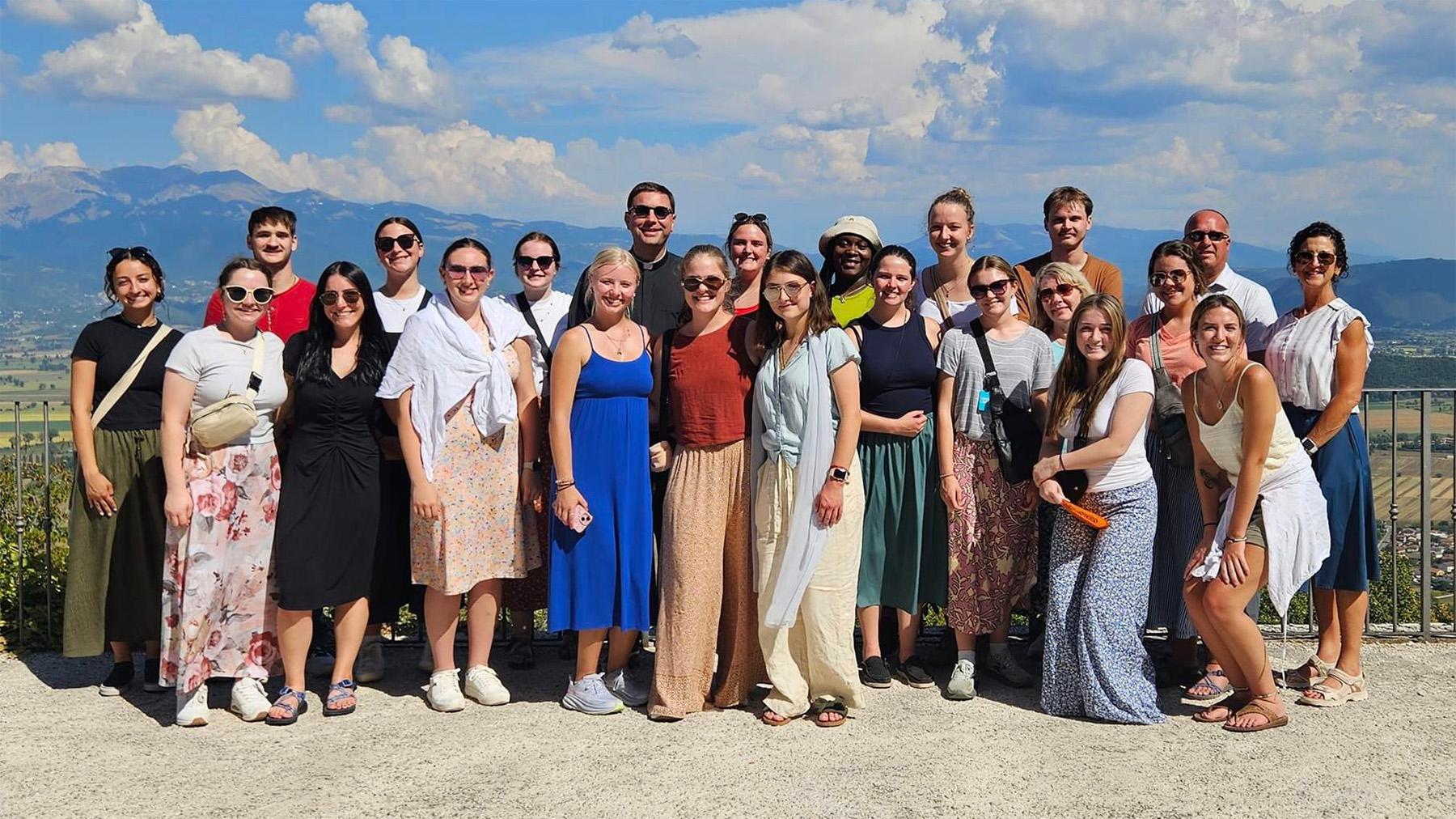
Nursing student on their pilgrimage

A life-changing journey through Europe with the 2024 Nursing Academy cohort
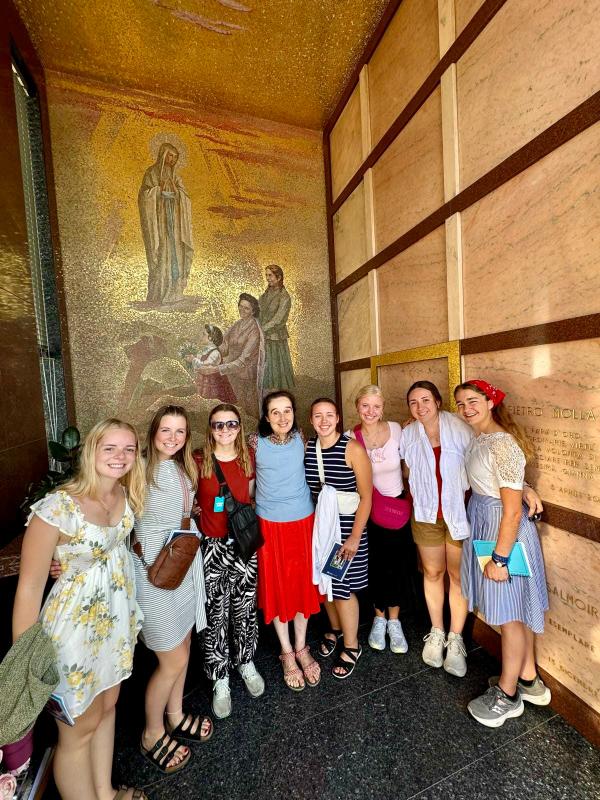
students with Saint Gianna's daughter
Many of the student pilgrims highlighted their time with Dr. Gianna Emanuela
Molla, fourth from left, as the most powerful experience of the trip.

This August, the University of Mary Nursing Academy’s first cohort embarked on a life-changing service-learning trip and pilgrimage through Italy, Germany, and France, accompanied by faculty members of the Saint Gianna School of Health Sciences; Monsignor James Shea and his brother, Father Robert Shea; and leaders from Sanford Health and CHI St. Alexius Health. This awe-inspiring experience left all who participated in it determined to, as one student said, “carry the lessons I learned on this trip with me for the rest of my life.”

The group learned early that it would be a trip that changed their hearts. When they stopped at the Catacombs, they saw where early Christians worshipped in secret to avoid persecution and reflected on how fortunate they are now to worship freely and openly. They also visited the Roman Colosseum, where many of those first courageous believers were killed for their faith. When the sights of ancient violence gave way to the beauty of the four major Basilicas and the Sistine Chapel, Dr. Billie Madler, Associate Dean of Nursing, says the group observed a common thread that would run through the entire pilgrimage: “the value of human life and our high calling as health care professionals and people of faith.” Madler says she came to realize in Rome that “the Saints were just everyday people who chose to do God’s will.”

At the Vatican Museum, there was a room with a painted ceiling divided into two sides. One side had a painting of philosophers, representing reason, and the other was a depiction of the Holy Trinity, representing faith. These paintings were beside each other to show that faith and reason belong together – if you separate them, you’re left with a narrowed perspective. To best care for people, we must be able to see each person as a whole rather than just their illness.

Courtney R., Nursing Student

The trip continued to inspire the travelers when they immersed themselves in the beautiful environment of the ancient city of Assisi, home of Saint Francis and Saint Clare, where they celebrated one of Italy’s national feast days and climbed the scenic Mount Subasio and contemplated the beauty of God’s creation as they looked out upon the Umbrian countryside. The group enjoyed absorbing the history of Assisi but soon traveled to Mesero, the hometown of Saint Gianna Beretta Molla, patroness of the University of Mary’s School of Health Sciences. This proved to be a highlight for many students. While there, the group spoke with Dr. Gianna Emanuela Molla, daughter of Saint Gianna, and visited the clinic where Saint Gianna worked before meeting at her tomb to pray at her gravesite. The entire day in Mesero was very moving for many students on the trip. “It was incredible to experience how passionate and filled with joy Dr. Gianna was about life,” one student said, “and meeting her taught me the importance of displaying a loving presence to others.” Another student remarked, “I want to model Saint Gianna’s love for her community in my future nursing career. Our time with Dr. Gianna made me realize that, as a future Catholic nurse, I have a duty to be a servant leader in my own community.”

The pilgrimage also included an opportunity to honor our Benedictine heritage. The group traveled to the Bavarian region of Germany to visit Eichstätt and the legendary Abbey of Saint Walburga. This Benedictine monastery houses the very Sisters from which Mary’s Sisters of Annunciation Monastery trace their roots. The group had Mass there, and a particular quote from Father Shea’s homily stood out to one student: “Without this place, we wouldn’t be here. See what happens when we say ‘Yes’ to God.”

At times, however, the pilgrimage turned its focus briefly on people who said ‘No’ to God. The group traveled to Munich to learn about the rise of Nazism and to Dachau to experience the horrors that occurred at the first of Nazi Germany’s concentration camps. The group also made a stop at Nuremberg, the site of the infamous trials at the end of World War II. Throughout this portion of the trip in Germany, the travelers learned what happens when medical science becomes divorced from genuine care for patients and the dignity of the human person.

“We were driving out of the concentration camp, and I looked out the window and saw a big neighborhood right across the street. You expect to see these big walls – you imagine no one could see what was actually going on across the street from their home. But the walls were short. Anyone could’ve seen into the camp while other human beings were being murdered and worked to death and cremated there. So I started to think of how much we see in the wider world and in our everyday lives. How often do we speak out?

Sarah Berreth, MSN, RN, Nursing Academy Coordinator

What struck many about their experience in Germany was how seemingly regular people could have committed such atrocities. Dr. Madler said, “We were all encouraged to ask ourselves how ordinary people — people like us — who took part in the Holocaust might have rationalized their actions.” This question affected the students deeply. One said, “Hearing actual testimonies from the people who committed the crimes was surreal; they truly believed they were just following orders and nothing else,” when the reality couldn’t have been further from the truth.

When the group’s hearts were full of sadness and disappointment about humanity’s potential for evil, the travelers needed some healing, and they found it in Lourdes, the famous and holy city full of miraculous healings. The group met with the director of the Medical Bureau of Lourdes, and everyone helped serve and care for those with illnesses and disabilities. They participated in a Eucharistic Procession that gave one student the trip’s most impactful moment: “I looked around towards the faces of the sick, who looked up at us in our scrubs, and it struck me how significant my role will be as a nurse. People look at nurses for comfort and hope during their most vulnerable moments.”

Despite how much darkness loomed over Dachau, the hope and light that came from the city of Lourdes completely overpowered it. It was there that I learned the significance of standing up for life and human dignity. There I saw the exact opposite of what happened in Dachau: the poor and sick were taken care of before everyone else. In the Eucharistic Procession of the Sick, they came first.

Liz H., Nursing Student

With their hope restored, the group celebrated its final night together in Lourdes and considered how they had all become different people than they’d been when they started the trip. “The places we visited and the talks we heard touched me mentally and spiritually, and they brought out emotions that are impossible to describe,” one student explained. Another shared the sentiment, saying, “This pilgrimage has been a profound gift in my life, in my formation as a nurse, and toward my relationship with God.” It’s astounding to see the impact that such a trip can have on the people involved, and it’s clear that August’s pilgrimage made an impression that Mary students and faculty will never forget.

Explore Topics