

Coaching Up: Dr. Rod Jonas Turns Dedication on the Court into a Leadership Career in Education

Dr. Rod Jonas translates hard work on the hardwood into a life of leadership in education
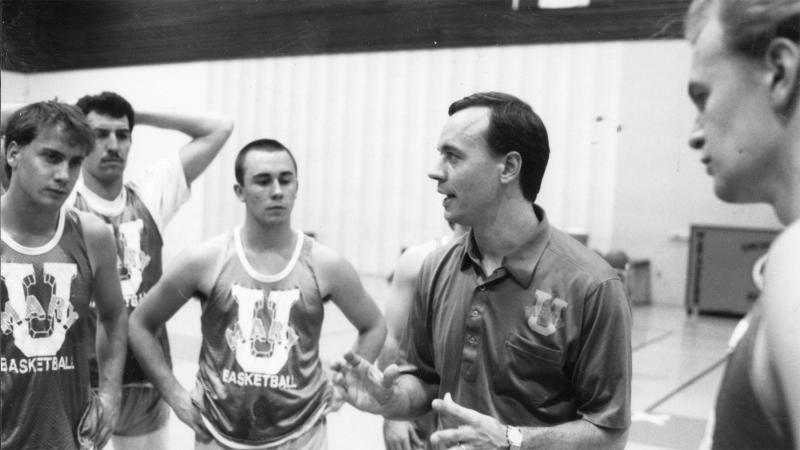
In the 1980s, long before the glossy hardwood of Bortke Court graced the inside of the McDowell Activity Center, Rod Jonas paced up and down the sidelines of Mary’s tartan basketball court as the head coach of the Marauders men’s team. Forty years later, with retirement approaching in May, Dr. Jonas is now dean of the Liffrig Family School of Education and Behavioral Sciences. Today, he points to those seasons coaching as the time he began to cultivate the leadership philosophy that would grow, adapt, and flourish during his decades-long career in higher education. But there’s more to Jonas’s leadership, and to his story.
“I wanted to see how badly you wanted to play.”
In the dairy farming community where Jonas grew up in rural southeastern Minnesota, hard work surrounded him everywhere he looked. “My dad ran the Goodyear elevator,” he said, “and my uncles were all dairy farmers, so watching them and helping them was how I learned to work.” Before long, however, young Jonas caught the basketball bug. Soon, he began looking for a place to practice, but there weren’t any courts or hoops available. “Even the school gym closed when the custodian went home for the day,” Jonas said. He needed a place where he could apply his work ethic to this game that had captured his imagination. The solution came in an unexpected place: a Quonset hut. Jonas’s father had mentioned that there was some empty space and plenty of height in the Quonset near the grain elevator; that was all Jonas needed to hear. “It was like Hoosiers,” he said. “We put up a plywood backboard and measured the 10 feet. My dad gave me the keys to the front door and said, ‘Just keep it clean.’” The following day, brimming with excitement, Jonas invited a few of his friends to test out the new court. When they arrived, they found dozens of seed pallets blocking their playing area. One by one, they began moving the pallets, but quickly became discouraged by their efforts. Jonas called his father from the office phone. “I told him, ‘Dad, there’s seed in the way,’ and he said, ‘Well, that’s too bad.’” Jonas and his pals shrugged and went back to work. Then they heard the Quonset door open. “In comes my dad on a forklift, and he moves all the pallets out, hands me a broom, and says, ‘Now you can play.’ As he turned away, I said, ‘Why didn’t you come earlier?’” His father’s answer has been etched in Jonas’s mind ever since: “I wanted to see how badly you wanted to play.” Jonas spent hours and hours on the Quonset court, even in the winter, resorting to shooting and dribbling with fingerless mitts and watching his breath cloud in the cold air. This practice and subsequent high school basketball success led Jonas to the Twin Cities and Augsburg College, where his teams won three conference championships, and he received All-Conference and All-American selections.
TO NORTH DAKOTA VIA SOUTH KOREA
Near the end of his college basketball career, Jonas began to explore an interest in coaching. Shortly before his graduation, Jonas saw an advertisement in the Augsburg Student Union about positions available at Seoul Foreign School in Seoul, South Korea. He was interested enough to participate in an afternoon interview to be the physical education teacher and boys’ basketball coach. “That evening,” Jonas said, “they called me and offered me the job.” After discussing the idea with his fiancée (now wife), Shirley, it was off to South Korea for two years. From the first year of his stint at Seoul Foreign School, Jonas remembers what he calls “horrid coaching.” Not having coached before, Jonas mimicked the personality of the people who had coached him, which included a lot of intensity and hard-nosed expectations. “It was ‘my way or the highway,’” Jonas says. “That was just the Bob Knight mentality at that time.” After dismal results that first season, Jonas quickly learned that he would need to become an authentic coach — one who interacted with players based on his true, core values. This realization — after only one year of coaching — became a pillar of his leadership philosophy and resulted in the Seoul Foreign School Crusaders winning the Far East Championship the following year. This shift toward authentic leadership didn’t merely result in athletic success, however. It formed the beginning of relationships with young athletes that have stayed strong more than 40 years later. “We had a reunion last summer,” Jonas said. “They gave me a scrapbook with pictures and memories of our championship season together.” Back in the United States, Jonas found his way to North Dakota State University (NDSU) and joined the staff of men’s basketball coach, Erv Inniger, who had been the coach at Augsburg when Jonas played there. Jonas became a graduate assistant coach while he completed his Master of Education degree, and the Bison won the North Central Conference championship in 1981, when Jonas was on the staff. After finishing his master’s, Jonas began receiving coaching interest from other schools, but a chance conversation with legendary NDSU athletic trainer Denis Isrow led Jonas down a different path. The two had been talking about the disappointing market for coaching jobs. “Denis told me to sit down,” Jonas said, “and I thought, ‘uh-oh.’” Isrow explained the volatility of the coaching world and encouraged Jonas to get his PhD and get a job in higher education. Jonas was convinced.
“I ended up going to the University of Minnesota and working as a research assistant for two years while completing all my PhD coursework, everything but my dissertation, but after that, my program had budget cutbacks,” Jonas said. He lost the health benefits associated with his position, and with a pregnant wife at home, the Jonas family packed up and returned to Fargo, where Jonas taught and coached the Fargo South High School Bruins. After reuniting with Coach Inniger for a season, Jonas received a call from Coach Al Bortke at the University of Mary — a small and relatively unknown school in Bismarck — who offered him the chance to coach the college’s men’s basketball team.
While he didn’t know much about the University of Mary, Jonas said, “I thought it gave me a job where I could get into the world of higher education while also coaching.” The best of both worlds, so to speak. He accepted.

LIFE AT MARY
Jonas jumped headfirst into coaching at Mary. In his second season, spurred by Corey Wilhelm, whom Jonas called “the heart of that team,” and future hall-of-famer Rory Entzi, the Marauders won the North Dakota College Athletic Conference championship. Jonas continued to coach for several more seasons, and all the while, he worked on his dissertation, which he finished in 1993. While coaching brought more successes in the 1993 and 1994 seasons, after the 1995 season, an opportunity arose to join Mary’s faculty full-time as the coordinator of the education department’s student teaching program. Jonas couldn’t pass it up.
He began applying the leadership techniques he had honed during his time on the court to the future educators under his direction. In 2009, Monsignor James Shea asked Jonas to be the first dean of the Liffrig Family School of Education and Behavioral Sciences. Suddenly, the recipients of the leadership philosophy Jonas had been refining shifted from athletes and student teachers to university faculty. “I had to learn that leading meant inspiring others and creating an environment where you allow your people to be the best version of themselves,” Jonas said. “I realized that if I wanted good faculty in the school of education, I needed to give people autonomy and the ability for them to create their own path and their own dreams. I had to be a transformational leader instead of a transactional leader.” He later captured these principles in his book, “Build a Dynamic Organizational Culture: ‘A 7-Step Team Approach.’” And transform he has. Under Jonas’ leadership, the Liffrig Family School of Education and Behavioral Sciences has grown in every way imaginable. There are more faculty, more programs — including a doctoral program — and more students. Most people responsible for that kind of growth would be thinking of the legacy they’ll leave. Not Rod Jonas.
“It’s not about me,” he said. “I don’t worry about my legacy. I worry about our [the university’s] legacy. I want people to see what we did as a group together, as faculty. I think we created something special.” And just like those early mornings and late nights clearing the court in the Quonset hut, Jonas sees his role as dean similarly: “I’m the broom-sweeper,” he said. “For a long time, my job has been to get the obstacles out of my faculty’s way.”
Jonas isn’t sure what retirement will bring, but he is sure about one thing regarding his career at the University of Mary: “I think God was involved,” Jonas said. “I’ve enjoyed this job more than anything I’ve ever done.”
Explore Topics
